
Logan County VINELink Coverage
Oklahoma uses VINE through the Oklahoma VINELink application. The Logan County Sheriff's Office places VINE directly on its in-custody inmate search and tells searchers to use it when a person may have been released or transferred. That official local referral makes VINE an important bridge after a current jail row disappears.
Coverage still depends on the reporting agency and its feed. VINELink may show county jail or Oklahoma state custody information when the participating source supplies it. It does not track a sentenced federal person in Bureau of Prisons custody. The same rule applies to status labels: report only the Custody Status, Custody Detail, Location, Reporting Agency, ID Number, or Supervision Status that the open record actually shows.
A person can leave Logan County custody without entering the community. The Logan County Detention Center holds county detainees and can also hold people under federal authority. A transfer to ODOC, a federal handoff, and a community release are distinct. VINELink can point to the change, while the release or transfer record identifies the disposition. Note: A no-match does not prove release because spelling, feed delay, agency availability, and record rules can affect results.
Current and historical records also differ. The sheriff roster is framed as in custody and does not keep a published released-person archive. VINE is useful for a named custody event, while Sheriff Records can produce the local booking-and-release entry when available. A state-sentenced person then belongs in ODOC records. Someone held only in the county jail may never have an ODOC profile. Choosing the source from the custody path prevents a state search from being treated as a complete Logan County release list. The right source depends on who held the person.
Search Logan County VINELink Records
The strongest search starts with a full name or known ID. Keep the last known booking agency and date nearby. If several records appear, compare the reporting agency, location, and identifiers before opening one. Never select a record on name alone when common names produce multiple results.
- Open Oklahoma in VINELink and choose the person or custody search.
- Enter the full first and last name, or use the agency ID when known.
- If exact spelling fails, enter at least two characters of the last name. A partial ID needs at least four characters, with leading zeroes left out.
- Compare the matches and open the record tied to the correct agency and person.
- Read the displayed status, custody detail, location, reporting agency, and as-of context. Do not assume a field that is absent.
- Contact the reporting facility when the exact release time, legal reason, or receiving agency matters.
The Logan County released-inmate search path adds the sheriff record, ODOC, court, and federal routes when VINELink alone cannot settle the question.
The manifest's successful capture links directly to the official Oklahoma person search.
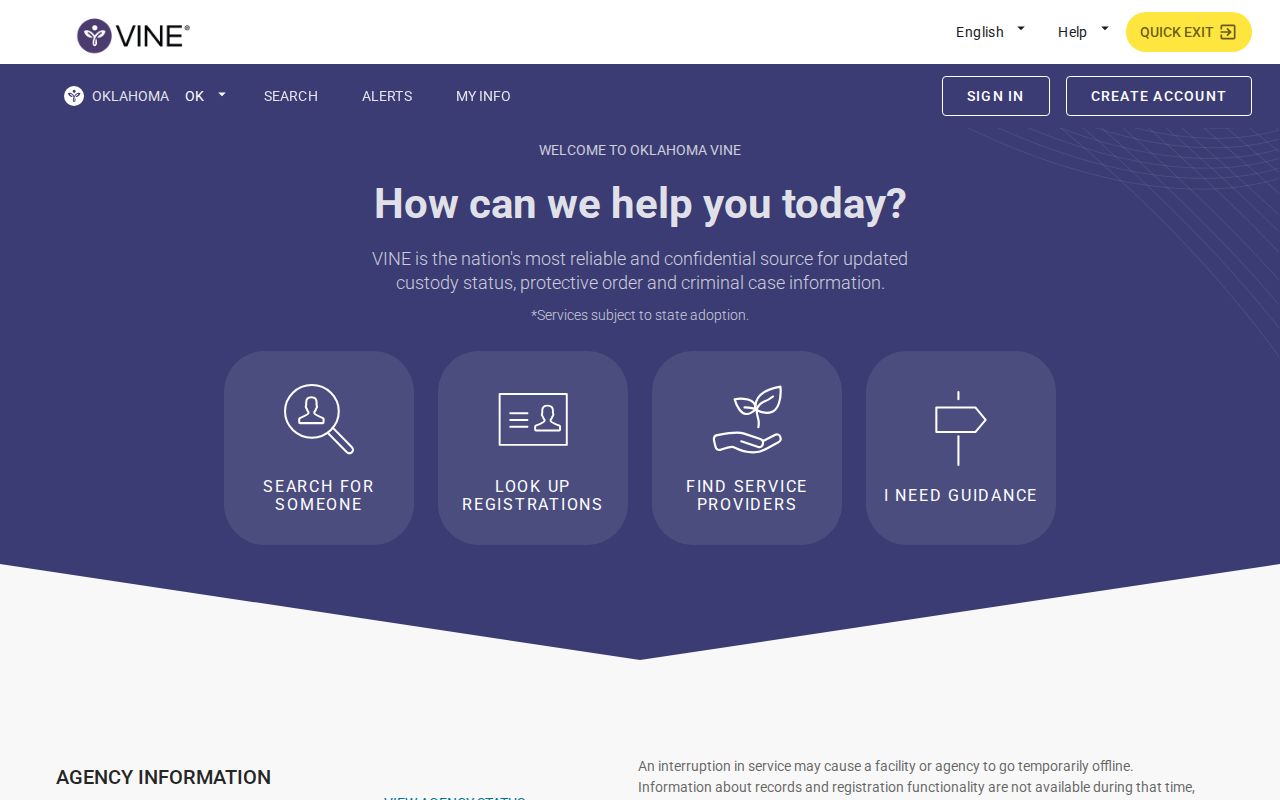
The search screen is the entry point for one-person custody checks and notification registration, not a countywide recent-release list.
Logan County VINELink Release Fields
VINELink fields vary with the agency feed. A Logan County result should be read as an agency-supplied status record, not as a promise that every item below will appear. A noncustodial status associated with the Logan reporting agency may corroborate departure from that custodian. A transfer detail instead points to continued custody.
| Field | What to verify |
|---|---|
| ID Number | Match the agency identifier to the person and any booking record. |
| Reporting Agency | Identify which jail, corrections agency, or other participant supplied the event. |
| Location | Read the displayed place as part of the reported custody record, not proof of a street release. |
| Custody Status | Quote the actual label and note when it was checked. |
| Custody Detail | Look for wording that separates a release from transfer or another change. |
| Supervision Status | Use only when supplied, then confirm parole or probation through ODOC. |
A missing current-roster row and a VINE change event are useful leads. The Logan County Sheriff's Records Division remains the local source for the booking-and-release entry, release date and time, and disposition or destination if maintained. That record resolves the crucial difference between release and transfer.
Set Logan County Release Alerts
Registration begins from the correct person record. Available methods may include phone, text, email, or in-app alerts. The methods and triggering events vary by state and reporting agency, so review the choices shown at registration rather than expecting every channel for every Logan County record.
- Open the matched record and select Register or Get Notified.
- Choose one of the methods offered for that record, such as phone, text, email, or in-app notice.
- Enter the destination, language, and other requested options.
- Continue to the PIN step and create a four-digit PIN.
- Enter the PIN again, review the event and contact method, and complete registration.
- For a notification call, listen to the message and enter the PIN followed by
#to confirm receipt and stop repeat calls for that event.
VINE may retry an unanswered call, but no fixed retry schedule should be assumed. A verified account can manage registrations and may support a universal PIN under current live help. Keep the PIN and notification address private. Never place either in a public screenshot.
Review every registration before saving it. Confirm the selected person, reporting agency, notification event, contact method, and language. A transfer alert may call for a search of the receiving custodian rather than a conclusion that the person is free. If a phone number or email changes, update the registration through the official account or repeat the process from the correct record. The alert is timely assistance, but the underlying agency record remains the authority for the legal event.
Help channels: The Logan sheriff lists Oklahoma VINE at 877-654-8463. VINELink's national live help displays 1-866-277-7477 as a round-the-clock support line.
Logan Sheriff's VINE Release Route
Logan County has an unusually clear local layer. The sheriff's inmate search says a missing person may have been released or transferred and embeds Oklahoma VINE as the next step. That message is more useful than a blank roster result because it names the ambiguity instead of turning absence into an unsupported release claim.
Use the sheriff's route in a three-part check. First, note whether the current roster returns the person and record the time checked. Next, read the VINELink agency and status details. Last, ask Sheriff Records for the release or transfer entry when destination matters. If the record says ODOC, follow the state offender record. If it names a federal handoff, use the proper federal custodian rather than treating the VINE change as community release.
A focused records request should identify the person, approximate booking date, and booking number when known. Ask for the booking-and-release entry, release date and time, release disposition, and receiving agency if maintained. Sheriff Records publishes Records@logancountyso.org, 405-282-4100, and 405-260-3252, with weekday office hours. Requesting the destination is crucial because the same roster disappearance can lead to the community, ODOC, another local custodian, or federal control.
This Logan-specific sequence also explains why the VINE phone number and the national help number should remain separately labeled. One comes from the county sheriff's local instructions. The other supports the national application. Note: VINELink is a notification and custody-status system, while the sheriff record documents the county's actual release event.
Logan County Registry Alerts Differ
VINE and offender registries serve different purposes. The Logan County OffenderWatch service offers an address-radius search and email alerts for new qualifying registrants near an address. The ODOC Sex and Violent Offender Registry is the statewide public registry. Neither source covers every person released from jail or prison.
A registry result documents qualifying registration status under the applicable law. It does not by itself establish the date or reason the person left the Logan County Detention Center. Likewise, no registry result proves only that the search returned no public qualifying match. It does not prove no booking, conviction, supervision, or release.
The official state registry image provides a useful contrast with a Logan County VINELink release check.
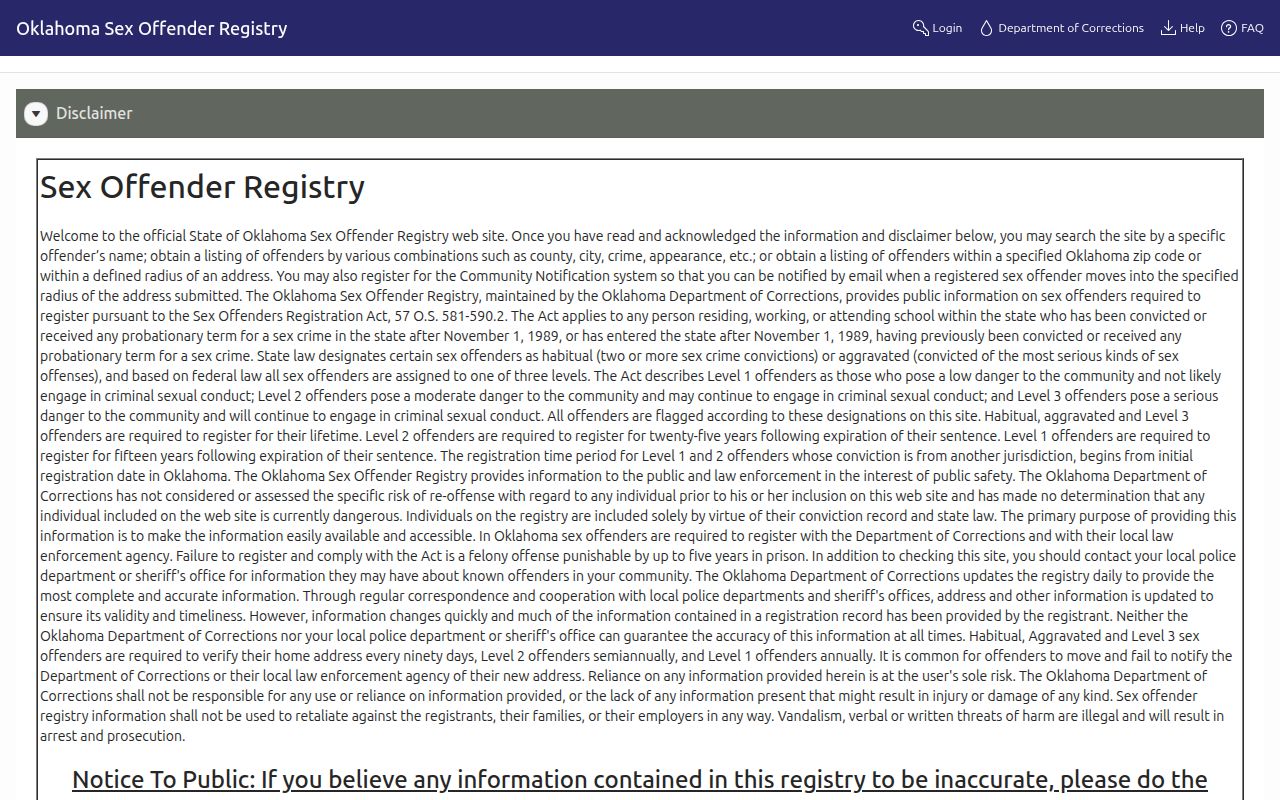
The registry is a narrow post-release channel for qualifying registrants. VINELink remains the named-person custody notification tool.
Confirm Logan County VINELink Results
VINELink participation, field availability, and timing can vary. An agency may be offline. A feed can lag. Spelling, an ID format, a suppressed or removed record, and nonparticipation can all produce no match. For that reason, a blank result must never be read as proof that a person was released.
Federal custody is another hard limit. A sentenced federal person belongs in the BOP Inmate Locator. An immigration detainee may require the ICE locator. A federal pretrial detainee can remain under U.S. Marshals authority without being a sentenced BOP prisoner. Logan County's federal contract use makes those distinctions locally important.
Confirm the event: Use the reporting agency's record for exact release time, reason, and destination. A VINE alert can arrive before every connected system updates.
For state prison custody, use the ODOC offender record and agency forms. For a county jail event, use Logan Sheriff Records. For the legal reason behind the release, the OSCN court docket may help, though it is not the jail's physical release log.
OSCN can show bond, dismissal, judgment and sentence, warrant activity, and later case entries. Those facts may explain a release, yet they do not prove that jail processing ended or that no other hold applied. Match the court case to the sheriff event. If the county record shows a receiving agency, continue with that custodian until the final status is clear. This source-by-source approach is slower than relying on one screen, but it preserves the difference between legal authorization, physical release, and continuing custody.